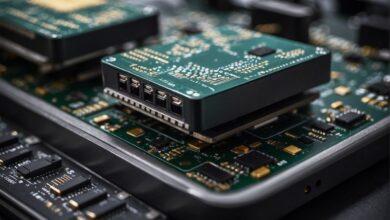
GE IS200CSLAH1A Turbine Control Board: What It Is and How It Works


Table of Contents
Modern power plants and industrial turbines run on layered control systems built from dozens of specialized circuit boards, each handling one narrow job inside a much larger network. General Electric’s Mark VI and EX2100e platforms are among the most widely deployed control systems in this space, and the IS200CSLAH1A is one of the smaller but essential boards that keeps that system talking to itself. Here’s what it does, how to recognize when it’s failing, and what to know before sourcing a replacement.
What Is the IS200CSLAH1A?
The IS200CSLAH1A is a Compact PCI Serial Link Expansion Board manufactured by General Electric as part of the EX2100e excitation control series — GE Vernova’s current-generation digital front-end, built on decades of excitation-control experience across gas, steam, and hydro applications. Its job is to extend serial link communication capacity, giving the control rack more bandwidth to exchange data between field-level modules and the main EX2100e control processor board.
- Manufacturer: General Electric (GE Power)
- Platform: EX2100e excitation control system (Mark VI family)
- Board type: Compact PCI Serial Link Expansion Board
- Operating temperature: roughly -30°C to 65°C, depending on the specific revision
- Conformal coating for resistance to moisture, dust, and other contaminants in industrial environments
- Ten high-speed transceivers handling both transmission and reception of on-board data
How It Fits Into the Control System
Turbine control racks are modular by design — as a plant’s monitoring and control needs grow, engineers add expansion boards rather than replacing the entire rack. The IS200CSLAH1A serves exactly that purpose: it acts as a high-speed serial link between the main EX2100e processor and other modules on the rack, so the central controller can keep pace with the volume of data moving through a large turbine installation.
Reading the LED Indicators
Like most GE Mark VI boards, the IS200CSLAH1A carries three status LEDs that give maintenance staff an immediate read on board health without needing a diagnostic tool.
| LED | State | Meaning |
| RUN | Steady green | Normal operation — the serial link is functioning within expected parameters |
| STATUS | Blinking yellow | A fault has been detected; investigate before it escalates |
| FAIL | Solid red | A critical or destructive fault, or a reset failure, has occurred |
Signs the Board May Be Failing
A few patterns tend to show up before a board needs to be pulled:
- A persistent blinking yellow STATUS light that doesn’t clear after a power cycle
- A solid or intermittent red FAIL indicator
- Communication dropouts or timeouts between the processor and connected field modules
- Errors logged against the serial link channel in the turbine control software
It’s worth ruling out cabling, connectors, and power supply issues first — a serial link fault doesn’t always mean the board itself is bad, and swapping a working board can mask the real problem.
Repair or Replace?
Because these boards sit in critical, expensive equipment, the industrial parts market around them includes new-old-stock (NOS), professionally rebuilt, and board-level repair options alongside brand-new units. Reputable suppliers function-test boards before shipping and can usually turn around a repair or replacement quickly given how disruptive unplanned turbine downtime is. As with any static-sensitive board, it should be handled by the edges with antistatic gloves and stored in ESD-safe packaging until installed.
How It Compares to Related GE Mark VI Boards
Part numbers in the IS200 family look similar at a glance but serve different roles. A quick comparison of the IS200CSLAH1A against a few boards it’s commonly grouped with:
| Part Number | Board Type | Primary Function |
| IS200CSLAH1A | Compact PCI Serial Link Expansion Board | Extends serial link communication to the main EX2100e processor |
| IS200CSLAH4A | Serial Link Expansion Board (later revision) | Same general role as the CSLAH1A, on an updated board revision |
| IS200EACFG3B | Exciter AC Feedback Board | Monitors AC feedback signals for exciter control |
| IS200HSLAH6A | High-Speed Serial Link Interface Board | Higher-throughput serial link interface |
| IS200JPDDG4A | Power Distribution Board | Distributes power across the control rack |
Because revisions aren’t always drop-in compatible with one another, it’s worth confirming the exact part number and revision against the system documentation before ordering a replacement.
Frequently Asked Questions
What system does the IS200CSLAH1A belong to?
It’s part of GE’s EX2100e excitation control platform, which is built on the broader Mark VI turbine control architecture used across many power generation and industrial sites.
What does the blinking yellow STATUS LED mean?
It indicates a fault has been detected on the board. It’s a signal to investigate — checking logs, connections, and related modules — rather than an automatic sign the board needs replacing.
Can a faulty IS200CSLAH1A be repaired instead of replaced?
In many cases, yes. Several industrial electronics repair shops specialize in board-level diagnostics and repair for GE Mark VI components, which can be a faster and lower-cost option than sourcing new stock.
Is the IS200CSLAH1A the same as the IS200CSLAH4A?
No. They’re both serial link expansion boards in the same family, but they’re different part numbers and revisions, and compatibility should be confirmed against your system’s documentation before substituting one for the other.
Where is this board typically sourced from?
Industrial automation parts distributors and turbine control repair specialists are the usual sources, offering new, rebuilt, and repaired units depending on availability and urgency.