
Precise Lap Split Calculator | Amazing News USA
Lap Split Calculator
Enter each lap time, add as many laps as you need, and instantly see splits, totals, and pace stats.
Queries Coverred Below
How to Use a Lap Split Calculator: The Complete Guide for Runners, Swimmers, and Racers
Welcome back to Amazing News USA. Whether you're chasing a personal best on the track, timing intervals in the pool, or reviewing a weekend motorsport session, a lap split calculator turns a messy stopwatch log into meaningful data in seconds. Instead of subtracting times by hand after every lap, this tool instantly compares your fastest lap, your slowest lap, and your overall average, so you know exactly where you gained or lost time. This guide explains what a lap split calculator does, how to use one correctly, and how to read the numbers it produces.
What Is a Lap Split Calculator?
A lap split calculator is a simple timing tool that takes the individual lap times you enter, whether from a run, a swim set, a cycling loop, or a race, and converts them into cumulative splits, an average lap, and a clear side-by-side comparison of your best and worst efforts. Rather than reaching for a separate calculator app between reps, a good one does the math the moment you finish typing in a time, and it lets you keep adding rows for as many laps as your session actually needs.
Why Runners, Swimmers, and Racers Rely on One
Pacing is everything in endurance sport, and a lap split calculator is what turns a page of raw numbers into an actual pacing strategy. It flags pacing fade before it costs an entire race rather than after the fact, saves you from doing mental math mid-workout when fatigue makes mistakes more likely, and highlights consistency, or the lack of it, across a full session instead of just one standout lap. Just as useful, it shows the cumulative time at every checkpoint, which often matters as much as any single lap time on its own.
How to Use a Lap Split Calculator, Step by Step
Using the tool only takes a minute once your times are in front of you:
- Pick your time format. Most calculators accept either minutes and seconds (like 1:32.40) or plain seconds (like 92.4), so choose whichever matches how your stopwatch or GPS watch displays results.
- Add a row for every lap you recorded. A properly built lap split calculator should never cap you at two or three entries; look for one that lets you keep adding laps until every interval from your session is accounted for.
- Enter each lap time in order, from lap one through the final lap.
- Double-check any lap that looks unusually fast or slow before you calculate, since a single mistyped digit will skew your average.
- Hit calculate and let it generate your splits automatically.
Reading Your Results
Once you run the numbers, a solid lap split calculator should hand back more than just a total time. It should give you the total time across every lap, an average lap that acts as your baseline pace, and a clearly marked best lap and slowest lap so you can see which interval to study and which one to review honestly. Alongside these, look for a cumulative time at each checkpoint, which tells you whether you're on pace for a target finish, and a delta for every lap showing how far it strayed from both your fastest effort and your own average.
Tips for Getting Accurate Splits
A lap split calculator is only as reliable as the data you feed it. Time from the same reference point every lap, such as the same painted line or the same doorway, rather than eyeballing it, and record to the hundredth of a second where possible instead of rounding to whole seconds, since small errors compound over many laps. If a lap looks like an outlier, re-enter it before trusting the results, since a fumbled stopwatch press is far more common than a genuinely dramatic lap.
It also helps to keep your raw times somewhere safe so you can re-run them later and track trends across weeks or months, the same way careful homeowners keep records before they ever need to estimate water damage cost after a storm. If you're also building grip and forearm strength for swimming starts or rowing, our guide on using a hand strengthener pairs well with a regular splits routine.
Who Actually Uses This Tool
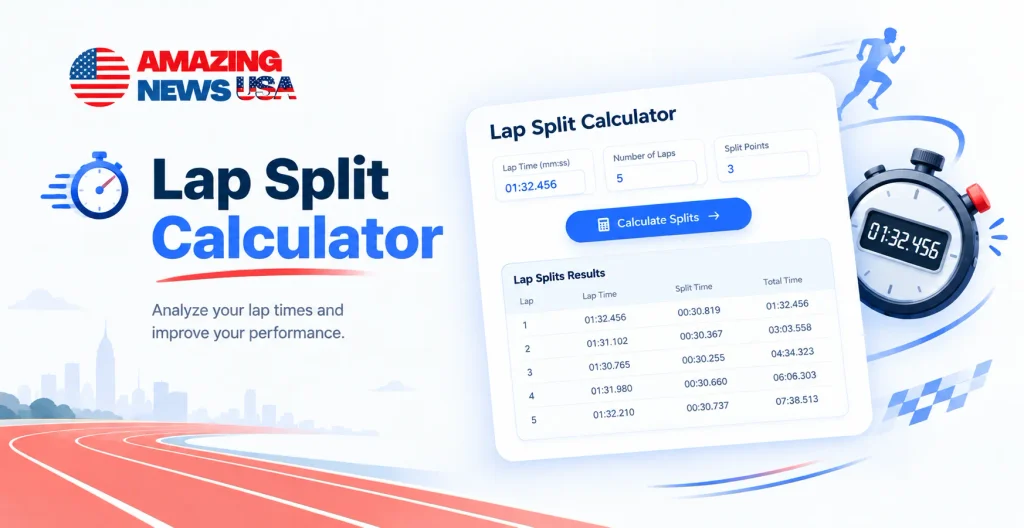
Track and cross-country runners use a lap split calculator to check whether they are running even splits or fading in the final laps, while swimmers use one to break a longer set into 50m or 100m intervals. Cyclists and motorsport fans take the same approach to compare sector times around a circuit, and coaches use it to spot athletes whose early pace is unsustainable long before race day arrives.
The same before-and-after mindset shows up outside of sport too, whether people are comparing relocation costs between the best US cities to live in 2026, or checking a domain's background through something like Brazilian domain registration and WHOIS before trusting a new website. If speed matters to you outside of the track too, our batch image converter, built for speedsters who don't like waiting around, is worth a look.
Frequently Asked Questions
Do I need special equipment to use a lap split calculator?
No. Any stopwatch, GPS watch, or phone timer works. You only need the individual lap times; the calculator handles the rest of the math.
Can I add more than two laps?
Yes, and you should be able to. A properly built lap split calculator lets you add as many laps as your session requires rather than locking you into a fixed number of entries.
Is a negative split good or bad?
A negative split, where your second half is faster than your first, is generally seen as strong pacing. The calculator makes it easy to see this at a glance by comparing early laps against later ones.
How is this different from just using a stopwatch?
A stopwatch only records time. A lap split calculator takes those recorded times and does the analysis for you, producing averages, deltas, and cumulative totals instantly instead of leaving you to work it out with pen and paper.
Final Thoughts
A lap split calculator will not run the race or swim the set for you, but it will tell you, precisely and immediately, whether your pacing plan is working. Athletes who check their numbers after every session tend to catch pacing problems weeks before those problems show up in a race result. Just as verifying a website's credentials matters before you trust it, as covered in this guide to website verification, verifying your own splits after every workout is what turns raw effort into real, measurable progress.