The Science Behind Cooking in Bronze: Heat Retention, Mineral Interaction & Taste
The Science Behind Cooking in Bronze: Heat Retention, Mineral Interaction & Taste

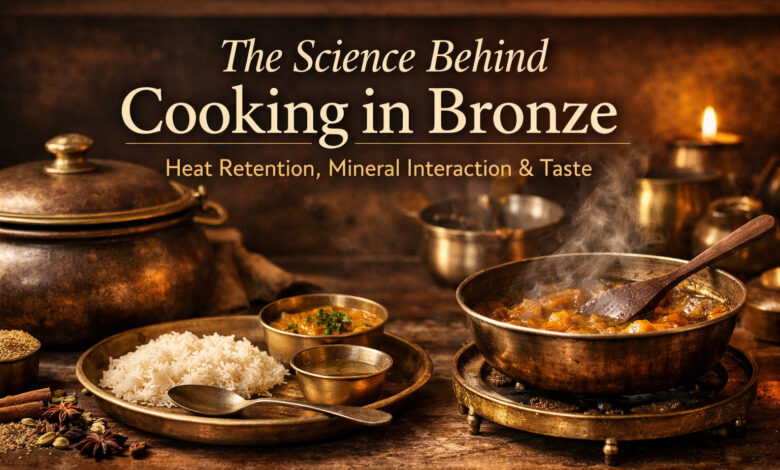
Cooking in bronze is often described as “traditional,” but its real value lies in material science rather than cultural belief. Long before stainless steel and non-stick cookware became standard, bronze was widely used because it delivered consistent heat, predictable cooking behavior, and long-term durability. These properties made it especially suitable for daily cooking, where control and reliability mattered more than speed or convenience.
This article explores the science behind cooking in bronze, focusing on heat retention, thermal stability, mineral interaction, and taste, while separating measurable facts from assumptions.
What Makes Bronze a Unique Cooking Material?
Bronze is an alloy primarily composed of copper and tin. Each metal contributes specific physical properties that directly influence cooking performance.
Copper is an excellent conductor of heat, allowing energy to move quickly and evenly across the surface of the utensil. Tin, on the other hand, improves structural stability and reduces excessive reactivity. Together, they create a metal that responds smoothly to heat without sudden spikes or weak spots.
This balance is the foundation of why cooking in bronze behaves differently from lightweight modern cookware.
Heat Retention: Why Bronze Cooks Food Evenly
One of the most important advantages of cooking in bronze is even heat distribution. When heat is applied, bronze spreads it uniformly rather than concentrating it in isolated areas.
As a result:
- Hot spots are minimized
- Sudden temperature fluctuations are reduced
- Food cooks gradually and consistently
This is particularly useful for slow-cooked foods such as dals, vegetables, gravies, and rice-based dishes, where uneven heat can lead to burning, uneven texture, or loss of flavor.
Unlike thin stainless steel or aluminum cookware that heats and cools rapidly, bronze maintains a steady cooking surface once warmed.
Thermal Stability and Cooking Control
Beyond heat distribution, bronze also offers high thermal inertia. Once heated, it retains temperature and cools down slowly.
This thermal stability provides several practical benefits:
- Reduced thermal shock to food
- Better moisture retention
- Lower risk of burning spices or proteins
Traditional Indian cooking methods rely heavily on controlled, sustained heat rather than high flames. Bronze naturally supports this approach without the need for artificial coatings, complex layering, or chemical finishes.
Mineral Interaction: Understanding the Reality
A common concern around metal cookware is mineral leaching. With bronze, this topic is often misunderstood or oversimplified.
When properly crafted and maintained:
- Bronze is chemically stable at normal cooking temperatures
- It does not aggressively react with food
- Any interaction is minimal and non-harmful
This stability is one reason bronze utensils were historically trusted for daily cooking, not limited to ceremonial or occasional use. Unlike damaged non-stick surfaces or poorly finished reactive metals, well-made bronze cookware maintains its integrity over repeated use.
Does Cooking in Bronze Change the Taste of Food?
Cooking in bronze does not add flavor to food. Instead, it helps preserve natural taste.
Because heat is distributed evenly:
- Spices cook without scorching
- Sugars caramelize more uniformly
- Aromas remain intact
Uneven or excessively harsh heat is one of the primary reasons food develops bitterness or flatness. By maintaining steady cooking conditions, bronze minimizes these issues and supports layered, balanced flavors.
This is why many households still prefer bronze utensils for cooking traditional recipes that depend on slow heat and gradual flavor development rather than rapid frying.
Durability: Why Bronze Utensils Last for Generations
Bronze cookware was chosen historically not for decoration, but for performance and longevity. Well-made bronze utensils:
- Withstand repeated heating cycles
- Do not chip, peel, or flake
- Maintain consistent cooking behavior over time
Unlike modern cookware that often prioritizes speed, coatings, or aesthetics, bronze was designed for reliability. This durability allowed utensils to be passed down across generations while retaining their functionality.
Today, manufacturers like Raj Gharana Metals continue this approach by producing bronze and kansa cookware intended for everyday use rather than display.
When Cooking in Bronze Makes Sense Today
Cooking in bronze is particularly well suited for:
- Slow cooking and simmering
- Boiling grains, lentils, and vegetables
- Traditional Indian meals
- Daily household cooking with controlled heat
It is not intended for extremely high-flame frying, similar to materials like cast iron or clay cookware. When used correctly, bronze offers a balanced combination of performance, safety, and longevity that many modern materials struggle to replicate.
Final Takeaway
Cooking in bronze works because of physics, not folklore.
Its heat retention, thermal stability, and neutral interaction with food explain why it has remained relevant for centuries. When understood scientifically and used properly, bronze cookware continues to be one of the most dependable choices for consistent, flavorful cooking in modern kitchens.